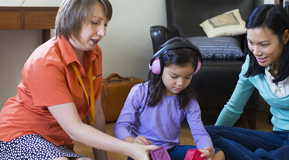
Our team of experienced and highly trained therapists are all trained to deliver services via telehealth. Click each question below to learn more about our telehealth services.
Understanding telehealth at SDN
Telehealth is an alternate, convenient way of delivering effective evidence-based therapy services and supports for children.
In many ways, it’s just like face-to-face therapy, but instead of driving to a clinic, or catching public transport, your face-to-face appointment is virtual, through the use of digital technology.
The number one advantage of choosing telehealth is that, no matter what restrictions are in place or where your child lives, they can receive regular therapy. For children who have autism or a developmental delay, we know that early intervention and continuity is really important to their ongoing success.
Because these online sessions occur in your home, it’s easier for you to adapt the strategies and skills your child learns in therapy to the home environment. Telehealth also allows us, as therapists to observe your child within the home environment and see how this environment can be used therapeutically.
Before your telehealth appointment, your therapist will plan how they can use your own space and materials to engage your child in therapy. They will work with you and provide you with tips and information on making your telehealth sessions successful. During the therapy, you and your therapist will work together as a team using a free app called Zoom, your therapist guiding you while you physically deliver the therapy. We will also use the technology to observe and, where possible, interact with your child. We have already seen instances where children who didn’t engage well with face-to-face therapy became more engaged when using telehealth technology.
Sessions are usually structured in the same way as face-to-face therapy sessions and can also include upskilling you in topics of interest, gathering more information (about behaviours, sensory, feeding, sleep and other areas) and working together to develop strategies and goals for the future.
For a Telehealth appointment you will require:
- A space with adequate lighting
- A device to use that has a camera and audio (phone, computer, tablet)
- Adequate internet connection
Your therapist will work with you around any additional resources that may be used for Telehealth services. The therapist will consider common items in the home environment that may be beneficial to use during Telehealth to support your child's goals.
Families can access all our allied health services via telehealth (where appropriate and suitable):
- Assessments
- Speech pathology
- Occupational Therapy
- Early intervention
- Behavioural support
Telehealth can be used for a range of different sessions including
- Goal setting and planning future planning of therapy
- Planning and support for NIDS meetings/renewals
- Observational or checklist assessments
- Communication techniques
- Emotional regulation and emotional intelligence
- Rapport building
- Turn-taking
- Articulation and speech development
- Self-care tasks
- Developing a routine within the home environment
- Modelling of behaviours and communication
- Engaging siblings in play
- Language of development
- Use of Key Word Sign (KWS)
Telehealth for your child and family
With the right preparation, telehealth can work well for many children with autism. Raising children’s Network has some useful information on how to prepare your child with autism for telehealth here.
Absolutely! The benefit of Telehealth is that we can do this anywhere. We can engage on the couch, in the backyard or in the kitchen. Therapists are creative and will consider the space, your child's abilities and engagement to problem solve during appointments.
Telehealth is also beneficial in that the therapist can work with you to engage with your child, developing your skills and abilities and providing valuable coaching and feedback.
All families can access our telehealth services, as long as you have access to a smart device or computer with internet access.
Telehealth appointments can be made more flexibly and at times that suit your child and family. If you’re concerned about how to make the most out of your child’s NDIS package, online appointments do not incur travel charges, making your child’s NDIS package stretch further.
Telehealth set up and support
Our therapists understand that technology can be challenging and we are more than happy to support you. We are happy to conduct a quick technical run before our first session to ensure you are confident using this and talk you through any challenges.
Technology can sometimes be unpredictable. If technical issues arise due to poor connection, your therapist will provide suggestions on of an alternative. This may be using a phone or a different application as a backup.
Just like face-to-face services, your therapist will abide by privacy and confidentiality principles. Therapists will often use passwords to restrict access to video conferencing platforms such as zoom. Therapists ensure they are in a private space to conduct sessions to maintain privacy during the sessions.
Telehealth services are extremely adaptable and can include parent coaching and education, creation of resources and completion of assessments.
There are a number of discussions that are equally effective over telehealth. Our initial family consultation (IFC), goal setting sessions, NDIS funding discussions, support team meetings and parent rated assessment questionnaires are just some of the supportive conversations that we can have using this modality.